Wednesday, August 29, 2012

Gallery: Zyta's Sashiko Hanten

This is a truly amazing sashiko hanten jacket  that my customer Zyta Cwalinska has created using patches of antique indigo cotton from our shop.


 Zyta only began sashiko last year and her first piece  was one of the viewers' choice winners in our exhibition in October.  Zyta's hanten was inspired by traditional sashiko stitched and patched fishermen's hanten. She has  beautifully stitched the lining as well  but somehow I forgot to get photos so I'll add them later if I get a chance. 


Zyta's sashiko reflects what I love about a lot of old sashiko. It's a very individual piece which is full of character and shows the hand of the person who created it.  There is a warmth to Zyta's stitching which has been lost in many modern sashiko projects. We think of sashiko being traditionally done on plain indigo but it was often stitched on patterned indigos such as kasuri (ikat) as well. The floral  katazome panels wouldn't have been typical on fishermen's hanten but give it a more feminine feel and look stunning.  The combination of the fabric pattern and the sashiko pattern makes each panel in the jacket unique and gives another dimension to its character.  Many thanks to Zyta for letting me share these photos of her amazing work.


Thursday, August 9, 2012

Autumn-Winter 1950

These photos are from an Autumn/Winter sewing and knitting book dated 1950.


Wednesday, August 1, 2012

Hera

We always have Clover brand hera marking styluses in stock and often have old bone ones as well. Hera were traditionally used to mark and crease fabric. They leave a silver mark on indigo cotton and were  used for marking sashiko patterns. Mrs Nagai who gave me my first sashiko lesson in Japan regularly used a hera to mark her work.  Modern hera are often made of plastic or resin but I don't think they work as well as old bone ones. They were made from ivory as well but I don't have any in my collection.
Here are the old and new hera that I have in the shop at the moment. I think I actually sell more for creasing paper than for using on fabric.


The rest of the photos are hera in my collection. Most of them have turned up in old sewing boxes that we buy to sell in the shop. An exception is this first one which has  my surname 'Ochi' written in katakana  and belonged to my mother-in-law Sonoko.


Most of my hera are made from bone and there is some variation in size and shape.


These are the smallest ones.  The shortest is 8cm long:


And finally a couple of plastic ones:


Thursday, July 26, 2012

Postcards

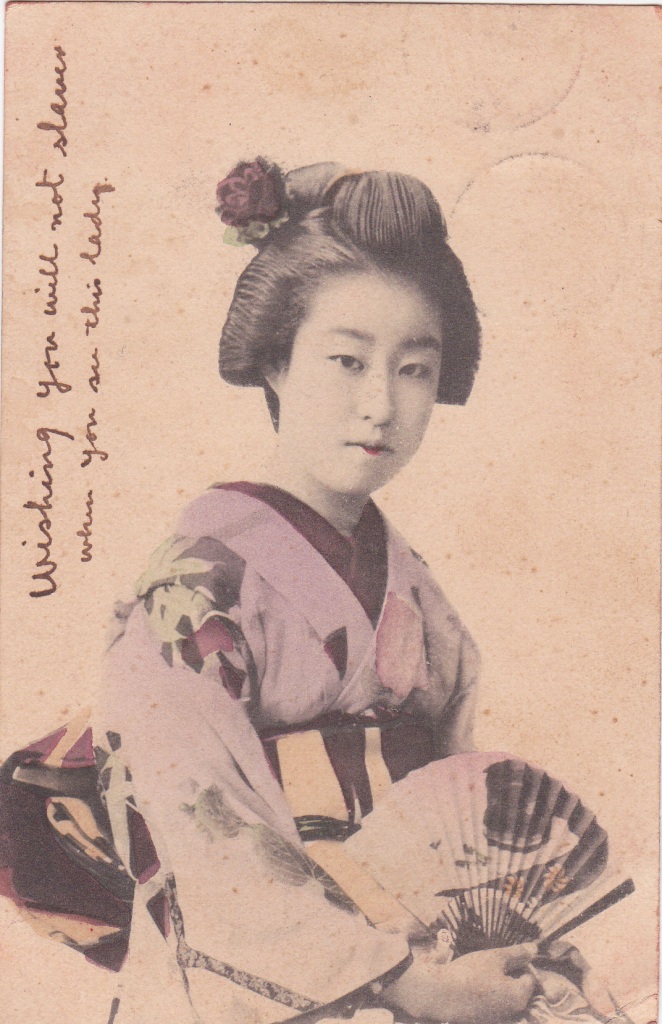
These lovely old Japanese postcards are from an album in my collection.  Most are dated 1905-6 (some a little later) and were posted to a Mr Hanaoka in Shanghai,  a few  with a  mixture of Japanese and English writing.   I've selected my favourite  images of Japanese women from the album.

This first young woman with a knowing look has a western style hairdo. The portraits with the softer western styles seem much less formal than the women with their tighter Japanese chignons.


The English caption on the next one reads 'Wishing you will not slaver when you see this lady' (!)


Another woman with a softer western style hairdo in a relaxed pose with western furniture but a very traditional Japanese insect cage.


It's unusual to see a portrait of a  Japanese woman of this period smiling and showing her teeth. I love this picture. 


A modern young woman playing tennis and wearing hakama.


This final postcard  was never posted. I suspect Mr Hanaoka just enjoyed having it in his collection.` The caption in Italian, French and English reads 'Japanese women bathing in the house'.


Tuesday, June 26, 2012

In store...

Some new things in the shop.

I have this lovely, fresh  cotton shibori by the metre:


We always have kokeshi dolls in the shop but I've just put out a new selection. Here are a few of them:

This creamy silk habutae feels beautiful.  Perfect for dyeing:


A vibrant cotton child's kimono - early- mid 20th century:


I love this old (pre-war) kimono - the silk is beautifully soft and the  subtle grey contrasts wonderfully with the red lining:


A Hotei (God of Happiness) incense burner: 


I've made up some quilters' vintage charm packs:


Monday, June 18, 2012

Meisen

At the moment we have some terrific meisen garments in the shop.  Meisen is a silk (or occasionally synthetic) ikat  which was developed in the late 19th century and was a popular mass-produced, everyday kimono fabric through until the post-war period.  It developed after the introduction of modern weaving and dyeing techniques from Europe.  These technical developments coincided with social reforms in the Meiji period which for the first time allowed ordinary people  to wear silk regardless of their traditional social status ( if they could afford it of course). Here's what we have in the shop right now. I love this bold check kimono. If it doesn't sell soon I'll keep it for my collection.


I also like this haori. The vibrant, dynamic design is typical of meisen.


And a couple more kimono.  The green one has a red silk lining which indicates that it's a pre-war garment. Post-war garments typically have a white lining though it isn't a hard and fast rule for dating meisen as some garments are recycled with a different lining.  And  of course some don't have linings at all. 


The following  is a fabric that I have in the shop. It's a traditional plum blossom design which isn't very typical of these vibrant meisen patterns.  In  early-mid 20th century meisen designers took much of their inspiration from the west,  and roses and stylised art deco floral motifs are more common than plum and cherry blossoms.


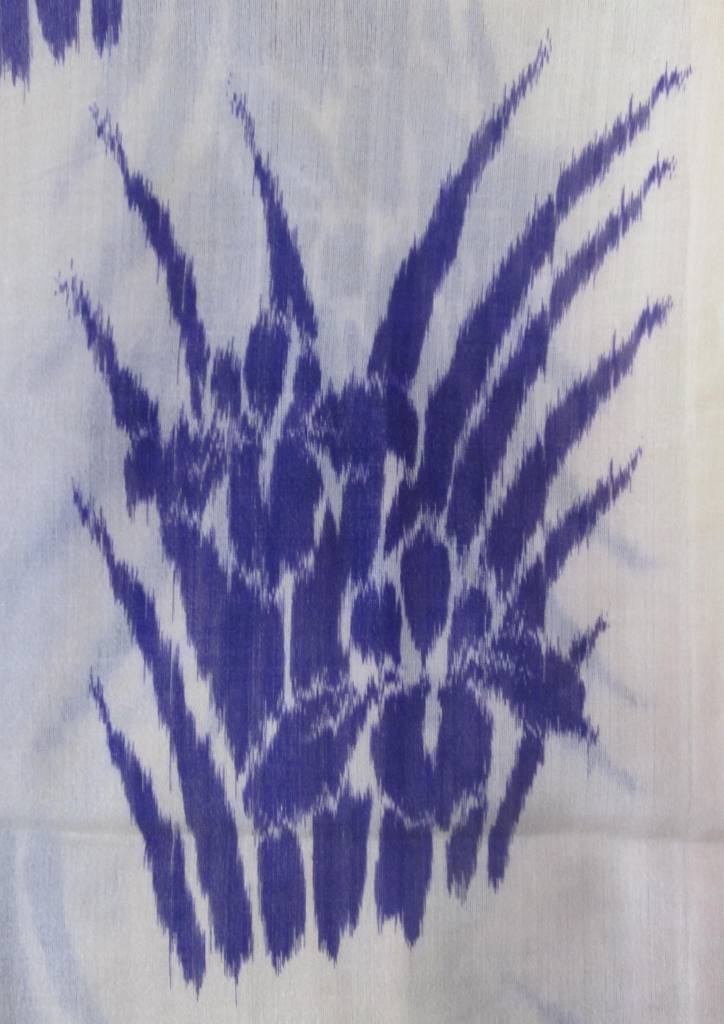
The rest of the photos are from my own collection.  This iris pattern is another traditional Japanese motif but earlier than the plum blossoms.  Unlike traditional cotton ikat (kasuri) in which the threads are tie-dyed before weaving, in meisen the threads are usually direct-dyed with a stencil and then woven. As with kasuri, the meisen technique necessarily creates a soft, fuzzy edged design which is very much part of its charm.  Often both the warp and weft threads are stencilled. In this 'ayame' iris design only the warp has been stencilled.


Here are some more typical meisen designs. I only have a  few in my collection (I just don't have the space to collect even a fraction of what I'd like to!) and there are much bolder designs out there with a stronger link to modern art movements. Here's some of what I have though.  I only just noticed what a limited colour range I have.  I think this is more a reflection of my taste than the  variety of vibrant fabrics that were produced! I will try and find some more designs to show you in a future blog.


Originally meisen was popular for all types of women from schoolgirls to geisha but it became very much the preferred kimono of the urban middle-class, and especially young women who wanted their traditional outfits with a western  touch. I can imagine the 'modern girls' of the 1920's and 30's promenading in the Ginza with their trendy bobs and their bold meisen kimonos.  Designs became more sombre in the pre-war and  early war time periods. The industry was restarted after the war but didn't survive long. Meisen kimonos were for everyday wear and not for formal occasions  and so as western clothing took over for everyday wear the demand for this kind of kimono decreased.  Meisen originated in Chichibu in Saitama prefecture not far from Tokyo and the major production centres were in the Kanto region around Tokyo. Another centre was Isezaki which had a long history of kasuri production. This is a  1920's or 30's poster that Takashi bought me recently advertising 'Isezaki Meisen':


* Much of my information has come from 'Meisen: Early 20th Century Fashion Kimono' by Annie Van Assche in Daruma: Japanese Art and Antiques magazine #22.  (It still makes me very sad that this fantastic magazine is no longer published)