Tuesday, June 18, 2013

In Store...

I've been rationalising my own collection because I just don't have enough space for everything I'd like to keep.  I'd kept this ceremonial  silk happi jacket (from a building foundation ceremony)  just because the silk is lovely and we don't usually get silk happis. But it has to go...

 
I'm very happy with this new cotton which arrived this morning. This is a little bit heavier weight than regular quilting fabric but would still be suitable for quilting or lots of other projects. It's 100% cotton,  112cm wide and made in Japan (as are all our new quilting fabrics).


I've  put out some  more  non-traditional 'creative kokeshi' and there are more to come. These are always very popular and sell quickly...
 
 
A roll of lovely rich blue silk shibori which I'm selling by the metre:
 
 
This wonderful late 19th century bronze bird ornament on a lacquer stand was most likely made for export. It looks like it has just jumped out of one of those old photos of a cluttered Victorian era sitting room...
 
 
And I've just put out a basket of vibrant silk shibori obiage (the tie that you can see poking out of the top of an obi).
 
 
Except for the bird ornament none of these items are on my website at the moment so please contact me directly if there's anything you're interested in.


Sunday, June 2, 2013

Workshops: June -July 2013

Here are some samples to give you an idea of what we will be making.  All our workshops allow for quite a bit of creativity  - we definitely  won't be all making the same thing. Please contact me to book or if you'd like more details.

OTEDAMA  beanbags (17th June):

Zabuton (floor cushion) style otedama:

 
These sashiko otedama were done by my daughter Ayame a few  years ago ...one missing:
 
 
Tawara (rice bag) style otedama:


BORO INSPIRATIONS  (23rd June or 15th July)
 
There will be a lot of freedom to create your own boro inspired work. You might like to have a look at original boro pieces on the internet (and I will have pieces there on the day) but here is some of my own boro inspired stitching. I'm still working on more samples:
 
Zabuton floor cushion:


Detail from a very humble boro furoshiki wrapping cloth I'm working on:


 A panel of patches:
 
 
A boro inspired noren that I made some years ago:


INTRODUCTION TO SASHIKO  (7th July)
 
Again with this workshop there will be a lot of freedom to choose your own design - either simple or more complicated:


Wednesday, May 15, 2013

Sample books

These days I am seriously limiting my own collection - simply because I don't have enough space for large textiles. But I always seem to be able to find room for more ephemera and books - including old sample books.  In previous posts  I've shown some of my old homemade  'shima-cho' sample books. The ones I'm showing this time are examples from commercial sample books and cards.

The first one are cottons on a  simple fold out sheet from 1911:


These are from a book of textile samples from 1924:


Some of the samples have had samples cut from them:
 
 
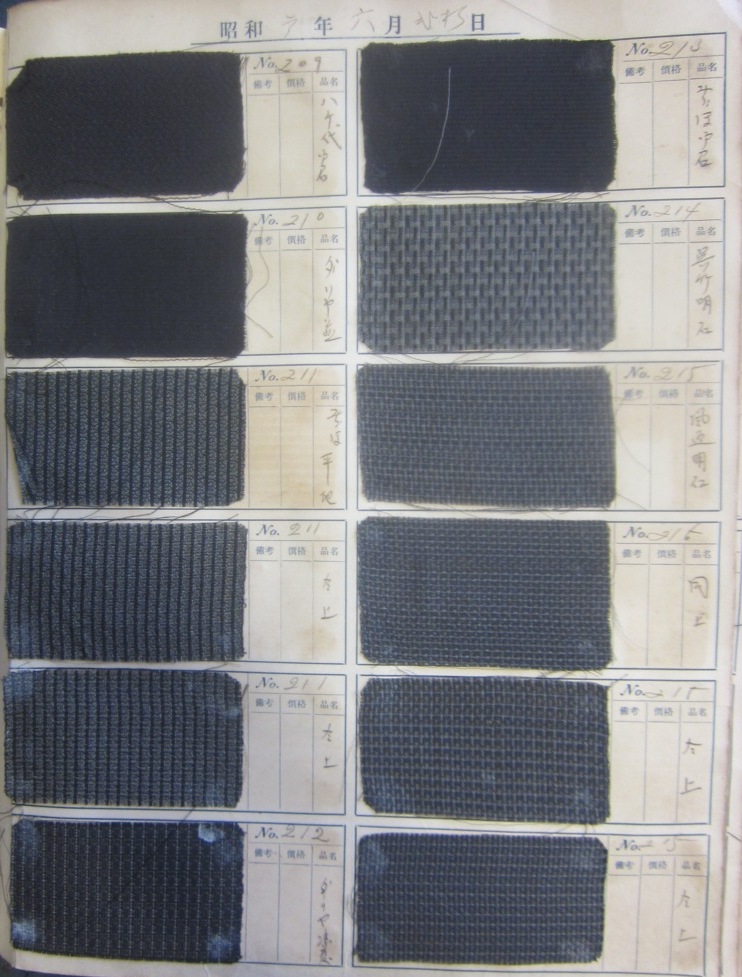
Some men's kimono fabrics from a sample book dated 1930-31:


Some dye colour samples dated 1902, from near our home in Ehime prefecture:


And finally a colour sample card for silk kimono threads and machine threads. This is undated but possibly from  just after the war:


Sunday, April 28, 2013

In Store...

I've been  puting out a few new things including these old unused Japanese plastic buckles and buttons.  Some of them are not very good quality (and are priced accordingly) but they all have a lovely old retro character:


This is an old Meiji era banko yaki (banko ware) sweet bowl with a crab design on one side. I'll be putting it on the website as well. Old banko yaki is wonderfully whimsical and doesn't fit the images that a lot of people have of Japanese ceramics. Its character speaks for itself:
 
 
I just put out a roll of this cotton shibori:


Some old 'soroban' abacuses. These have a lovely character just to keep as objects. When I first went to Japan one of our English students gave me soroban lessons but I never became proficient at it - at all.  I had some very young (maybe 5 or 6yo)  students later on who also learned soroban and I was impressed with how quick they were at mental arithmetic. My husband Takashi still regularly uses a soroban for doing the accounts for his business:


Monday, April 22, 2013

1950's 'style'

We just acquired this selection of  1950's clothing patterns cut from newspaper. They're  sorted into  large envelopes neatly labelled  by brush:  'Boys' Patterns', 'Children - Adults - Pants ('pantsu')', 'Women's collar patterns' , 'Children - Adults - Pants ('zubon') patterns'.  There are any number of patterns in each envelope.
 
There is also a smaller envelope made from an old poster titled 'style collection' which holds cuttings from magazines. It's an interesting glimpse into 1950's taste (click on any of the pictures to enlarge):


A couple of pages of summer hairstyles by Nakahara Junichi:
 

And some autumn hairstyles:


It looks like there might have been plans for a family wedding:
 
 
This wedding cake looks delicious compared to the huge fake  (rubber?) monstrosities that were the vogue by the time I first went to Japan in the 80's.  At the first wedding I  ever went to the 'cake' must have been at least twelve foot tall. It's a very long time since I've been to a Japanese wedding so I don't know if that's still what they do but I hope it's fad that is dying out!
 
 
At typical  Japanese weddings the bride changes her outfit up to six times. Four seemed standard in our area: a white kimono for the ceremony, a brightly coloured kimono, a western wedding dress and then a voluminous 'cocktail dress'.  These bridal outfits from the 50's are very elegant: