
Showing posts with label kasuri. Show all posts
Showing posts with label kasuri. Show all posts
Monday, May 11, 2015


Thursday, April 16, 2015

Thursday, March 5, 2015

Monday, February 2, 2015
potd - Antique Japanese Cotton
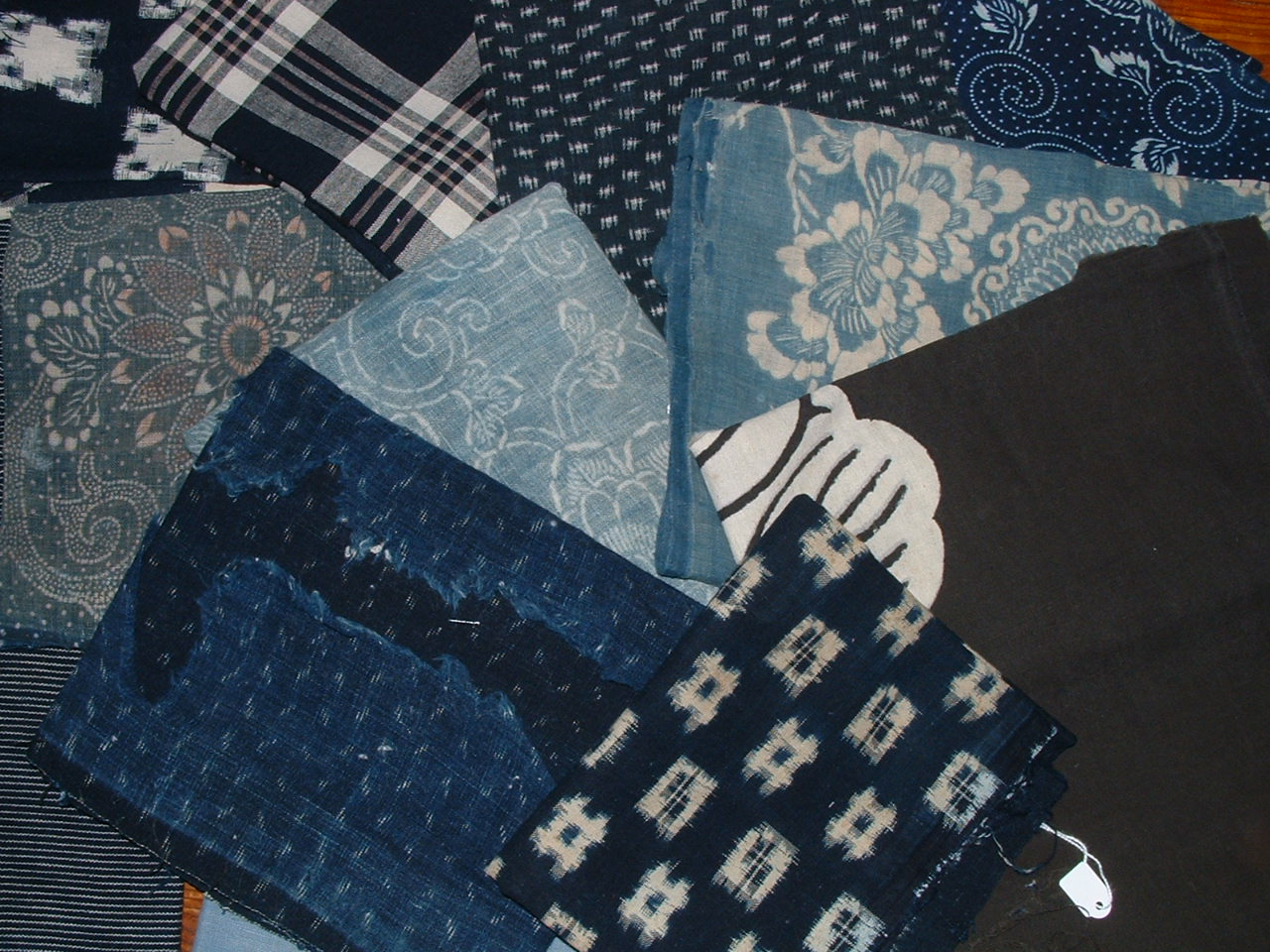
I've been putting out more antique indigo cotton. These are mostly hand-dyed and handwoven kasuri and katazome. Kasuri is Japanese ikat in which the threads (warp and weft or just weft) are tie-dyed before weaving. Katazome ('stencil dyeing') involves stencilling a rice paste resist before dyeing, creating designs such as these flowers and cranes. These date from the late 19th to mid- 20th century and are taken from old bedding and clothing.


Tuesday, January 27, 2015
potd - Egasuri
I just put out this panel of egasuri ('picture ikat' ) indigo cotton with a wonderful koi carp design. It's handwoven and probably dates from early-mid 20th century but the bubble pattern is very modern.

Wednesday, December 17, 2014
potd - Egasuri
I just put out this wonderful piece of e-gasuri (picture -ikat) antique indigo cotton. This is something very special and one of my favourites of all the kasuri pieces we've had in the shop over the years.

Monday, February 21, 2011
In store - some recent additions
I've had trouble keeping up with the blog over the summer but now the kids are back at school and Takashi's gone back to Japan for a while I should be able to post more regularly. Today I'm posting some recent additions to the shop...
First are two panels of old Iyo-gasuri which is kasuri from Matsuyama city, very near to where we have our Japanese home in Ehime prefecture on Shikoku. Iyo is the old name for Ehime. I'm sure I'll write more about kasuri in the future. Basically it is Japanese ikat where the warp and/or weft threads are tie-dyed before weaving. Where undyed sections of warp and weft thread meets the pattern will be white. The lighter blue/grey colour is created where only the weft threads are undyed. These pieces are e-gasuri or 'picture kasuri'. The one on the left is a koi carp and on the right is a Daruma with a butterfly, toy drum and pine tree. These panels would orginally have been parts of futon covers and probably date from the early 20th century.

Next are some very simple but interesting old wooden print blocks. I can't tell you much about them I'm afraid, even whether they were used on fabric or some sort of paper (possibly fusuma screen doors?) but they have a nice humble character and we have a basket of them.

This is part of a wonderful old ranru or boro patched futon cover. I couldn't fit the whole thing in the picture. Please have a look at my earlier post on boro for more information.

And finally, I've put out quite a lot more obi of various ages, styles, sizes, fibres, textures and condition.

Thursday, September 2, 2010
In store... old indigo
This week I've been ironing up more antique indigo cotton and I'm in the process of pricing it and putting it out in the shop at the moment. These are mostly lovely old katazome and kasuri pieces that have come from clothing and futon covers. (The futon covers fabrics often take a very long time to iron because even if they've been well-washed they always have bits of old cotton wadding stuck to them!). These are mostly from the late 19th - early 20th century but I'm putting out some more of the newer (1950's - 1970's?) kasuri as well. Here are some of the older pieces....

Quite a lot of the old indigo comes to us in less than perfect condition so today I'm making up one big basket of all the old faded, holey and patched pieces.... it should be a real treat for those of you (like me) who love the character of textiles that have already had a long full life...
Wednesday, August 18, 2010
Children's kimono Part 1
I often have customers asking for kimono for their children to wear but unfortunately we don't have a lot of everyday children's kimono come through the shop (the cotton kasuri kimono you can see in the shop photo at the top of the blog is an exception). Most of the old children's kimono we have are small children's ceremonial silk kimono which are usually quite expensive and more suited to hanging on the wall than wearing. This is simply because ceremonial kimono are the ones that have survived over the years. They were rarely worn and were then carefully stored as family treasures. In contrast a lot fewer everyday kimono have survived without being stained, torn and completely worn out or recycled into something else. And in more recent years children simply haven't worn kimono as everyday clothing.
Here are a few early-mid 20th century children's kimono from my collection. You can click on any of the photos to enlarge them for a closer look. The first one looks very similar to the cotton kasuri kimono in the shop photo but is actually made of rayon. It's very worn and almost in tatters. Kasuri is a Japanese ikat, a textile technique in which threads are bound and dyed before they are woven. It's traditionally hand-dyed and woven in indigo on cotton but from the late 19th century various machine produced versions such as this became available.
 People don't usually think of kimono being made from rayon but Japan developed a large rayon industry after the first world war and by the 1930's was one of the major producers in the world. We get some lovely girls' rayon kimono fabrics from that period as well. This kind of kasuri kimono was standard boy's wear in the early-mid 20th century as you can see from this old school photo from 1924:


Here are a few early-mid 20th century children's kimono from my collection. You can click on any of the photos to enlarge them for a closer look. The first one looks very similar to the cotton kasuri kimono in the shop photo but is actually made of rayon. It's very worn and almost in tatters. Kasuri is a Japanese ikat, a textile technique in which threads are bound and dyed before they are woven. It's traditionally hand-dyed and woven in indigo on cotton but from the late 19th century various machine produced versions such as this became available.


The next one is a dark brown boy's padded cotton kasuri winter kimono from the 1930's. It's in excellent condition but the front is still marked with reminders of a number of long ago meals.

The last one is my favourite. This is a very small child's summer kimono made from finely striped indigo dyed ramie. It's a similar age to the first two (or perhaps slightly older) and has probably been recycled from an adult's kimono. It still has a rusty safety pin in the front that has been used to fasten it.

None of these items are of much monetary value but have great value in my collection. They all have their own character and interest and add a little bit to our sense of life in Japan in the pre-war years when traditional textiles were still part of everyday life.
Subscribe to:
Posts (Atom)