I got back from Japan last week and have been busy catching up with all the jobs that need to be done here. I hope to be posting more regularly again now.
One of the highlights of this trip was meeting Ikuko Miyazaki a wonderful dollmaker from Okayama. Takashi had been researching imon ningyo dolls for me on the internet and came across Miyazaki-san's story of how her father's imon-ningyo inspired her lifelong passion for dollmaking. Takashi contacted her and she very generously invited our family to visit.
Imon ningyo are small 'comfort dolls' (aka 'mascot dolls') that were handstitched by Japanese women and girls during the war to send to soldiers in 'comfort bags'. Later in the war they were also carried by kamikaze pilots on their final missions. I've been fascinated by these dolls since I first read about them in a paper by Ellen Schattschneider* (Thank you to Victoria Eaves-Young who first introduced me to the article, knowing my interest in both sarubobo amulet dolls and wartime homefront textiles). Surviving dolls are now rare and it isn't easy even to find pictures and information. In part 2 of this story I'll talk more about imon ningyo and show some of the original patterns etc that Takashi has found and in part 3 I hope to share the story of another lovely woman we met on this trip who made imon ningyo as a high school student, one of which has survived.
This is Miyazaki-san's father's imon ningyo:
It's about 20cm long (many are much smaller) and like many of the dolls is a woman in wartime dress carrying a baby on her back. Miyazaki-san found it in her father's desk drawer when she was ten and asked if she could play with it. He said 'no' without any explanation which confused her as she couldn't understand why a man would want a little doll like that. She asked her mother who told her that her father had received it in an imon bukuro (comfort bag) during the war and had brought it back with him. It may be hard to imagine how soldiers felt about receiving these dolls but the way that Miyazaki-san's father had treasured this for the rest of his life shows what importance the doll held for him. Miyazaki-san felt that it had been especially comforting to him because he had lost his mother as a young child.
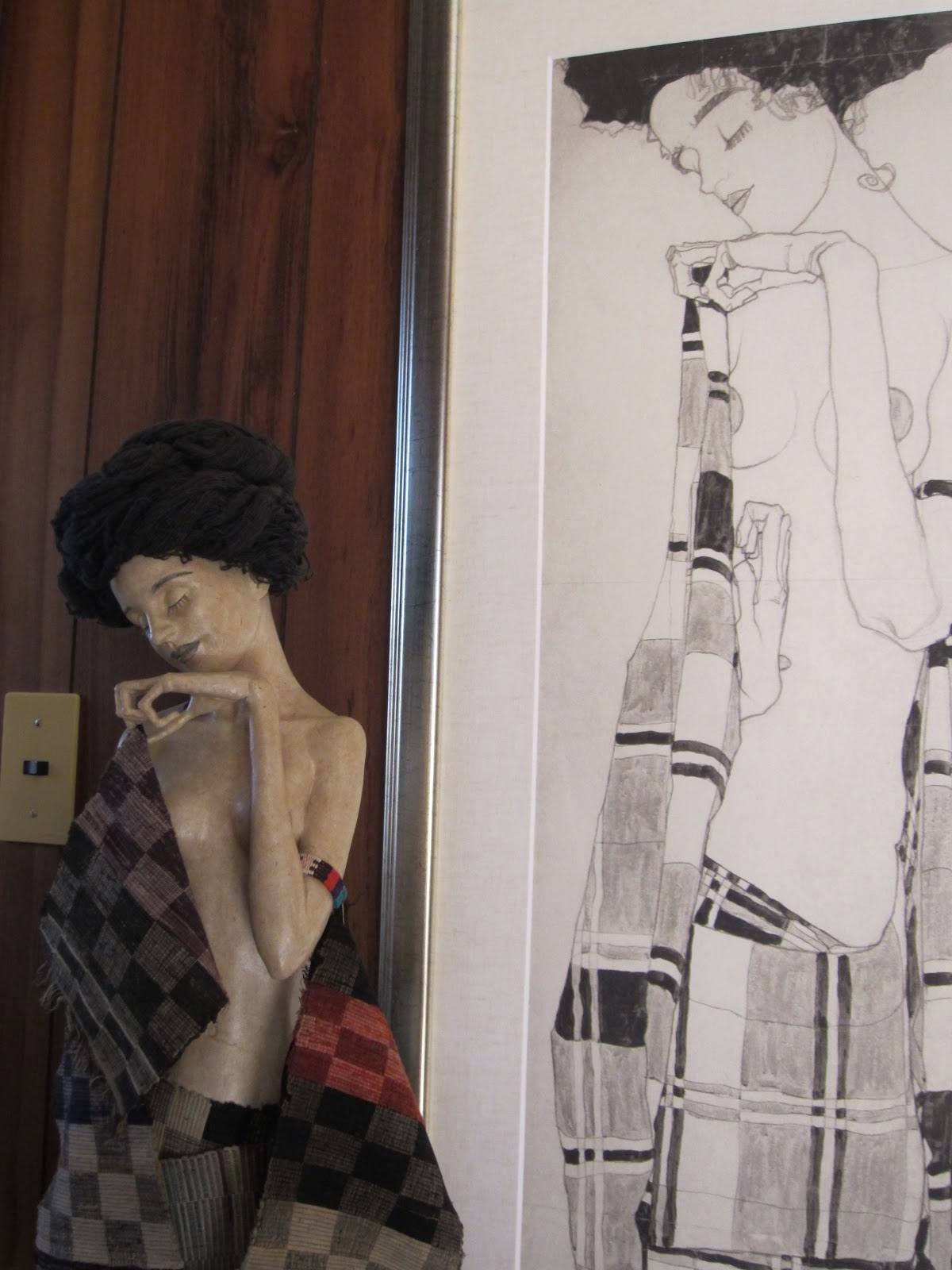
This experience inspired Miyazaki-san to begin making her own dolls, which she continues to do now. For the last 15 years she's been making art dolls based on the paintings of Austrian painter Egon Schiele, which she has exhibited around Japan and in Prague. These dolls are amazing! Some are larger than life and all are exquisitely made. I'm not sure how many she normally has around her house but she had put out even more to greet us in every hallway, through the window and even in the garden. The photos below are only a small sample. It was an incredible welcome:
After the earthquake and tsunami in March it didn't feel right to her to be enjoying the luxury of making her art dolls and so instead Miyazaki-san began making these lovely simple wrapped dolls to send to the survivors. They're based on Guatemalan worry dolls.
It was really a pleasure and a privilege to meet Miyazaki-san. She generously welcomed the four of us into her home, shared the story of her father's imon ningyo and introduced us (too modestly) to her own incredible works of art. She made us feel instantly at home and like we were old friends. I know I will be meeting her again and am looking forward to seeing what she creates next. If anyone is interested in seeing more of her dolls her website (with some English) is
http://www1.ocn.ne.jp/~kmz/
*Ellen Schattschneider, 'The Bloodstained Doll: Violence and the Gift in Wartime Japan' in the Journal of Japanese Studies, 31:2, 2005