
Showing posts with label accessories. Show all posts
Showing posts with label accessories. Show all posts
Wednesday, November 12, 2014
potd - Bamboo Bag Handles
We still have lots of these real bamboo bag handles in varying sizes. Very retro and cheaper than plastic ones.


Sunday, November 2, 2014

Wednesday, August 1, 2012
Hera
We always have Clover brand hera marking styluses in stock and often have old bone ones as well. Hera were traditionally used to mark and crease fabric. They leave a silver mark on indigo cotton and were used for marking sashiko patterns. Mrs Nagai who gave me my first sashiko lesson in Japan regularly used a hera to mark her work. Modern hera are often made of plastic or resin but I don't think they work as well as old bone ones. They were made from ivory as well but I don't have any in my collection.
Here are the old and new hera that I have in the shop at the moment. I think I actually sell more for creasing paper than for using on fabric.



Here are the old and new hera that I have in the shop at the moment. I think I actually sell more for creasing paper than for using on fabric.

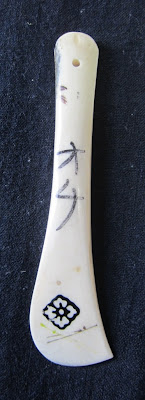
The rest of the photos are hera in my collection. Most of them have turned up in old sewing boxes that we buy to sell in the shop. An exception is this first one which has my surname 'Ochi' written in katakana and belonged to my mother-in-law Sonoko.

Most of my hera are made from bone and there is some variation in size and shape.


These are the smallest ones. The shortest is 8cm long:

And finally a couple of plastic ones:

Sunday, April 29, 2012
In Store - Stamps
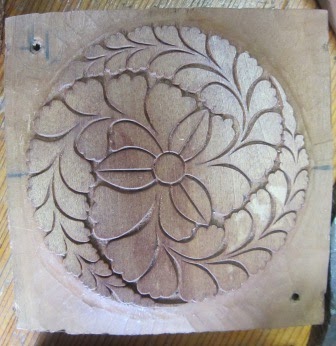
We often have various old Japanese stamps in the shop and they're always popular. The box of old wooden textile stamps that I put out this week are definitely my favourites so far. There's a mix of traditional motifs including some very finely carved kamon (family crests). I took these photos before I put them out in the shop and quite a few of them have already gone. I've been strong and only kept one for myself - I would love to have kept them all.


Saturday, October 22, 2011
In store...
Here are few things that I've just put out in the shop:


I like having a mix of old and new threads and accessories in the shop and it's fun when they're old but brand-new at the same time like these lovely old Clover brand awls. Clover dates back to the 1920's and I often have Clover needles and other items popping up in old sewing boxes, and of course Clover is still making great quality products which I'm glad to stock in the shop as well.

I've also put out these interesting threads which are silk coated with lacquer. They're not very strong but have an unusual texture which would be great for embellishing. They would originally have been used for embroidering on haori jackets.
Tenugui are simple unhemmed traditional handtowels made from lightweight cotton. This selection comes from a box of unopened tenugui that had been gifts for the well-known Kyoto geisha Mamechiyo (1912-2004). They were still in their original gift envelopes and had been presented by maiko (apprentice geisha) and others. Many were badly discoloured with age so I've just chosen a few that were in perfect condition.
And finally some lovely old hikite handles from fusuma screen doors that I'll be putting out this week:


Tuesday, March 8, 2011
Katagami stencils
Here are some katagami stencils from my collection, including some of the stencils which I used images from in my last newsletter. These stencils are made from layers of washi paper which are treated with persimmon tannin and smoked to make them waterproof and durable. They are then finely cut by hand and in more open patterns fine silk threads are added between the layers of paper to stabilise the design. Katagami stencils are used in a variety of Japanese textile traditions including yuzen dyeing which usually involves building up a design with a selection of stencils and colours in combination with other techniques, komon ( 'small pattern') and chugata ('medium stencil') kimono fabrics, and indigo-dyed katazome (lit.stencil dyed) futon cover fabrics. What these techniques have in common is the use of a rice-paste resist applied through a stencil either with a brush or special spatula.
These stencils all date from late-19th - early 20th century. Most will have been used on kimono fabrics but the first one at least would more likely have been used on an indigo futon cover. The rope and anchor designs were often used separately on futon covers which were part of a trousseau, as an alternative to the more traditional marriage imagery such as cranes, pines or turtles.
You can click on any of the images for a closer look.


These stencils all date from late-19th - early 20th century. Most will have been used on kimono fabrics but the first one at least would more likely have been used on an indigo futon cover. The rope and anchor designs were often used separately on futon covers which were part of a trousseau, as an alternative to the more traditional marriage imagery such as cranes, pines or turtles.
You can click on any of the images for a closer look.


Tuesday, November 16, 2010
Itomaki bobbins
One of the things I enjoy about this blog is the opportunity to bring pieces from my collection out of their boxes and drawers to look at again and share. Most of the bobbins I'm showing today have been collected over the years from old sewing boxes that we've bought to sell in the shop. I always love opening them to see what little treasures have been left - pins and needles, threads, thimbles, buttons, hasami scissors and less obvious things like old combs, make-up and medicines. The variety and character of the old bobbins makes them irresistible. This is only a sample of the ones that have turned up - I keep one little drawerful just to look at and enjoy and another that I use for my own sewing threads. They add something a bit special that you don't get from a piece of cardboard.
Most of the bobbins are plain wood but come in a variety of shapes, sizes and grains:

Sometimes the wood has been carved, branded or stamped:

And at least one has been stamped and then doodled on...

Others have been handpainted:

These ones have been lacquered:

Here are a few plastic and promotional ones:

And here are a few others - some made from paper and some from a kind of raffia-like fibre (I'm sure there is a name for this parquet type work but I can't think of it) :

This time of the year always gets a little hectic so I'm having trouble sticking to my plan to post on here every week - but I will do so as often as I get the chance.
Most of the bobbins are plain wood but come in a variety of shapes, sizes and grains:


Others have been handpainted:


And here are a few others - some made from paper and some from a kind of raffia-like fibre (I'm sure there is a name for this parquet type work but I can't think of it) :

This time of the year always gets a little hectic so I'm having trouble sticking to my plan to post on here every week - but I will do so as often as I get the chance.
Subscribe to:
Posts (Atom)