Tuesday, September 18, 2012

Uchiwa Fans

Walking the streets of Tokyo or other large city on a humid Japanese summer day you are often presented with  small uchiwa fans advertising local businesses.  Promotional uchiwa are not a new trend. They were a popular advertising medium in  the Taisho period (1912-26) and possibly long before that.  The fans below  probably date from that period. I don't collect fans but I kept the first two because of the textile designs. The third one belongs to my son Hikaru who is a train enthusiast.

This first one is from  Yajima's general store in present day Kofu.  The woman is wearing what appears to be an Arimatsu shibori yukata with a stunning plover design:

 
On the reverse side the old phone advertises a two digit phone number and tells us that the shop sells such things  as cosmetics,  school requirements, 'zakka'  general goods,  small items for the home, Western goods etc.


The next uchiwa is advertising a kimono/clothing shop.  The woman on the front seems to be holding her own uchiwa with a sun design that reflects the design on the actual uchiwa. The other items are bolts of kimono fabric. They are beautifully presented held together with red thread. I still often get bolts of  old  kimono or lining silk presented like this.


The design on the reverse features paper tags typically used for labelling kimono fabrics and a pair of 'hasami' scissors . I'm not sure what the needle like thing  attached to the hasami is.
 
 
This final uchiwa is advertising a food shop with items listed including sweets, oil, 'natto' fermented soy beans, sugar etc.


Wednesday, September 5, 2012

In Store...

I've just put out a few more netsuke, including these three that are still attached. The first is a smooth, flat  gourd design and is attached to a leather lined kinchaku which probably dates from Meiji period. I love this:

 
This tiger and bamboo netsuke is a little older and is attached to an old tobacco pouch in not very good condition:
 
 
The last one is a delicate shiitake design netsuke attached to a small  damaged inro (case for medicine etc) . The inro doesn't really have any value but it's nice to have the little set together.
 
 
I've just put out a couple more rolls of silk shibori.  They both date from about the 1960's. I haven't had a lovely roll of allover kanoko shibori in the shop before:
 
 
This vibrant pink one is quite lovely:


I have these cotton bundles for sale on my website as well. They're made up of  antique indigo remnants in varying conditions. They're perfect  for  quilters and textile artists with a taste for 'boro' and all things rustic.
 
 
I had these lovely old Japanese glass beads in the shop a few years ago and just discovered that I still had some more (it's like that here!)  Based on the original packaging I think they date from mid 20th century.


Customers sometimes ask if I sell fabric with pre-printed sashiko patterns.  We only sell old indigo for traditional sashiko  ( you can of course do sashiko designs on any fabric that your needle and thread go through!) and I have never tried to source new sashiko fabrics pre-printed or plain. I like the character of the old fabrics and they usually have a more open weave which is easy to stitch.  I unpick most of the sashiko fabric from old futon covers and sometimes work jackets and linings ( we usually refer to this fabric as 'uraji' which just means lining).  I wash it, de-fluff it (it often still has old futon wadding stuck to it)  and  because it's  never in perfect condition divide it up into usable pieces (including remnants and patched pieces).  I decided to put patterns on some of the smaller panels. They're ready to stitch  to use as panels in quilts or smaller projects or you can just hem them to use as a table mat. If  they sell I'll keep doing it... it really doesn't take long to transfer a pattern with chalk paper.


It's impossible to put everything we have  in the shop on my website.  If you're ever interested in purchashing something from my 'in store' posts and can't make it into the shop  just give me a call or send me an email.  


Wednesday, August 29, 2012

Gallery: Zyta's Sashiko Hanten

This is a truly amazing sashiko hanten jacket  that my customer Zyta Cwalinska has created using patches of antique indigo cotton from our shop.


 Zyta only began sashiko last year and her first piece  was one of the viewers' choice winners in our exhibition in October.  Zyta's hanten was inspired by traditional sashiko stitched and patched fishermen's hanten. She has  beautifully stitched the lining as well  but somehow I forgot to get photos so I'll add them later if I get a chance. 


Zyta's sashiko reflects what I love about a lot of old sashiko. It's a very individual piece which is full of character and shows the hand of the person who created it.  There is a warmth to Zyta's stitching which has been lost in many modern sashiko projects. We think of sashiko being traditionally done on plain indigo but it was often stitched on patterned indigos such as kasuri (ikat) as well. The floral  katazome panels wouldn't have been typical on fishermen's hanten but give it a more feminine feel and look stunning.  The combination of the fabric pattern and the sashiko pattern makes each panel in the jacket unique and gives another dimension to its character.  Many thanks to Zyta for letting me share these photos of her amazing work.


Thursday, August 9, 2012

Autumn-Winter 1950

These photos are from an Autumn/Winter sewing and knitting book dated 1950.


Wednesday, August 1, 2012

Hera

We always have Clover brand hera marking styluses in stock and often have old bone ones as well. Hera were traditionally used to mark and crease fabric. They leave a silver mark on indigo cotton and were  used for marking sashiko patterns. Mrs Nagai who gave me my first sashiko lesson in Japan regularly used a hera to mark her work.  Modern hera are often made of plastic or resin but I don't think they work as well as old bone ones. They were made from ivory as well but I don't have any in my collection.
Here are the old and new hera that I have in the shop at the moment. I think I actually sell more for creasing paper than for using on fabric.


The rest of the photos are hera in my collection. Most of them have turned up in old sewing boxes that we buy to sell in the shop. An exception is this first one which has  my surname 'Ochi' written in katakana  and belonged to my mother-in-law Sonoko.


Most of my hera are made from bone and there is some variation in size and shape.


These are the smallest ones.  The shortest is 8cm long:


And finally a couple of plastic ones:


Thursday, July 26, 2012

Postcards

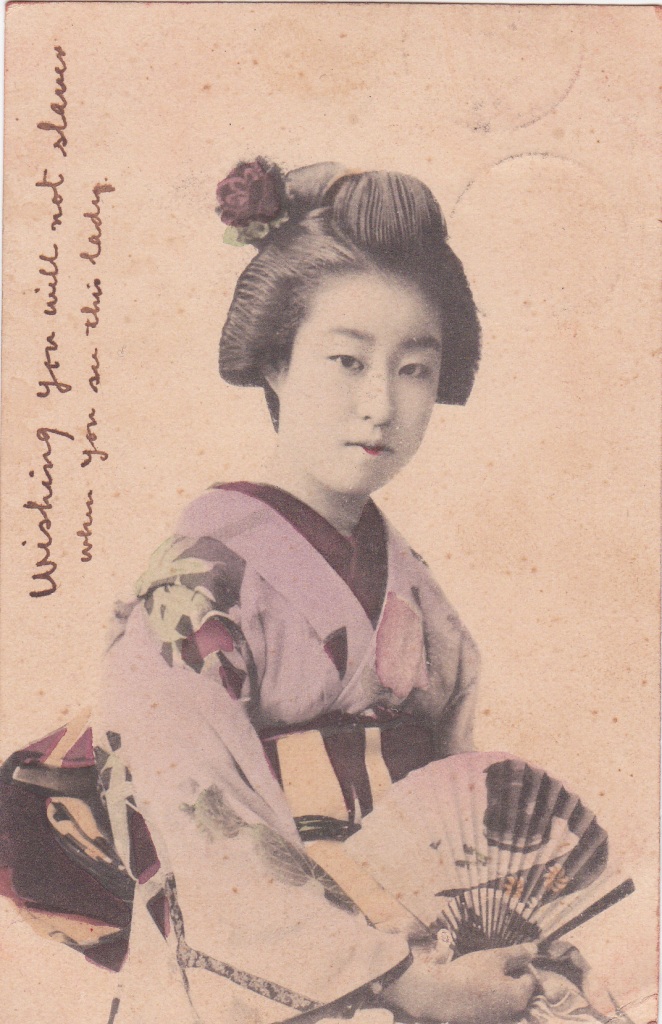
These lovely old Japanese postcards are from an album in my collection.  Most are dated 1905-6 (some a little later) and were posted to a Mr Hanaoka in Shanghai,  a few  with a  mixture of Japanese and English writing.   I've selected my favourite  images of Japanese women from the album.

This first young woman with a knowing look has a western style hairdo. The portraits with the softer western styles seem much less formal than the women with their tighter Japanese chignons.


The English caption on the next one reads 'Wishing you will not slaver when you see this lady' (!)


Another woman with a softer western style hairdo in a relaxed pose with western furniture but a very traditional Japanese insect cage.


It's unusual to see a portrait of a  Japanese woman of this period smiling and showing her teeth. I love this picture. 


A modern young woman playing tennis and wearing hakama.


This final postcard  was never posted. I suspect Mr Hanaoka just enjoyed having it in his collection.` The caption in Italian, French and English reads 'Japanese women bathing in the house'.